Publications
A collection of my research work.
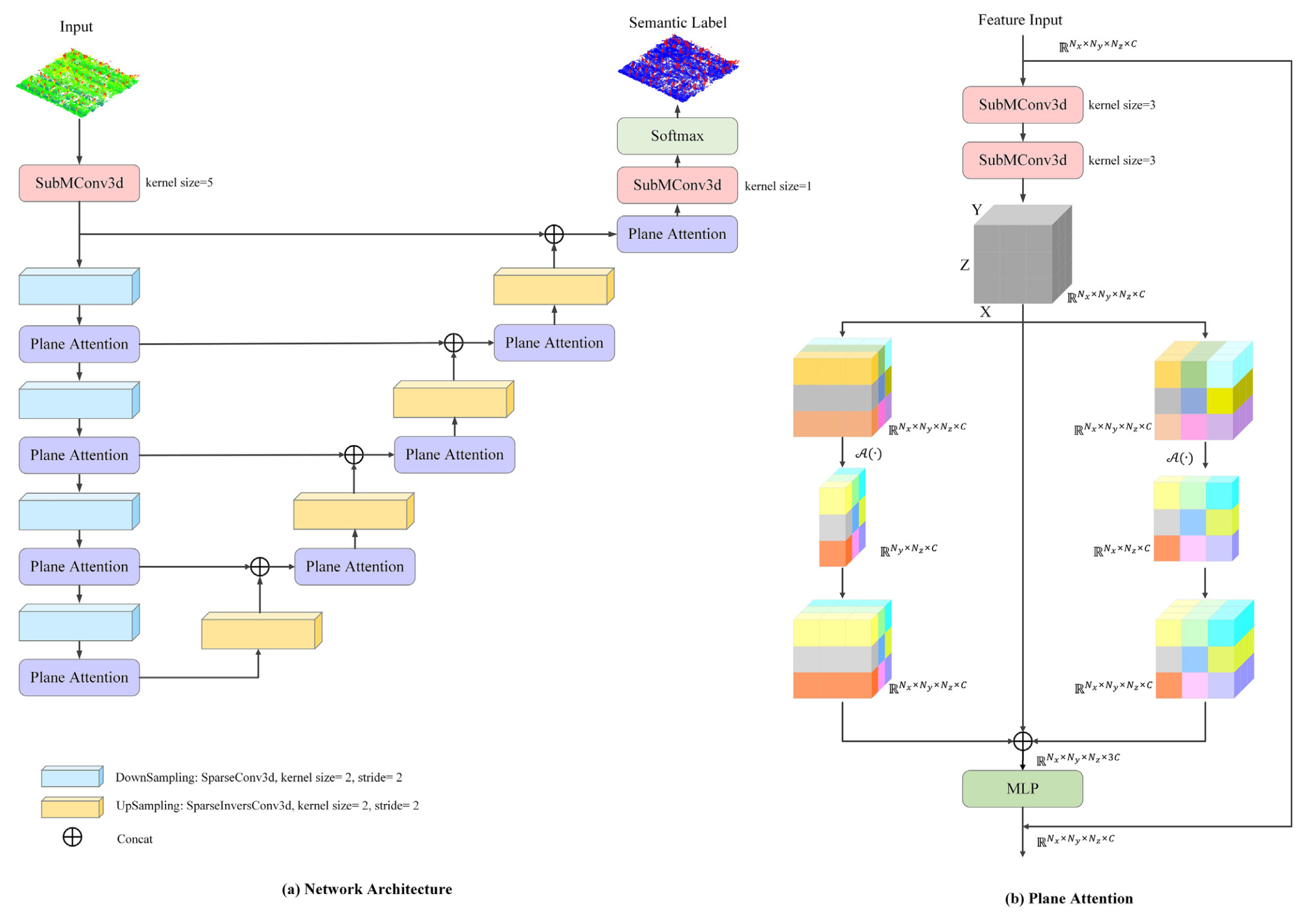
PlaneSegNet: A Deep Learning Network with Plane Attention for Plant Point Cloud Segmentation in Agricultural Environments
Xin Yang, Chenyi Xu, Yan Wang, Ruixia Feng, Jinshi Yu, Zichen Su, Teng Miao, Tongyu Xu
Artificial Intelligence in Agriculture 2026
PlaneSegNet is a voxel-based semantic segmentation network featuring a novel plane attention module that fuses projection features from the XZ and YZ planes to better capture vertical geometric structures. Designed for complex agricultural environments, it effectively addresses challenges such as high noise, dense plant distribution, and ambiguous boundaries between plant and non-plant regions. Evaluated across diverse scenarios—including open fields, greenhouses, and large rural landscapes—PlaneSegNet outperforms both geometry-based and deep learning baselines in plant/non-plant separation, enabling direct extraction of high-quality plant-only point clouds with minimal manual preprocessing. The dataset and code are publicly available.

SMFCA-Net: Sparse Multifrequency Cross-Attention Network for Single-Plant Point Cloud Classification and Segmentation
Xin Yang, Zhijun Shang, He Huang, Congjun Liu, Tongyu Xu, Teng Miao
IEEE Transactions on Geoscience and Remote Sensing 2026
SMFCA-Net is a frequency-aware sparse point-cloud framework for single-plant classification and segmentation, designed to mitigate the feature oversmoothing and fine-detail loss caused by repeated downsampling in U-shaped and pyramidal networks. It introduces a multifrequency Fourier cross-attention (MFCA) module embedded in the sparse U-Net bottleneck, which jointly models long-range context and local structures by operating in the spectral domain. The MFCA bottleneck follows a three-stage pipeline: (1) frequency decomposition via 3-D FFT to split features into low-, mid-, and high-frequency bands; (2) frequency-aware cross-attention to enable cross-band interactions guided by mid-frequency semantics; and (3) cross-frequency adaptive fusion that aggregates enhanced bands with learnable weights. Extensive experiments across multiple crops and acquisition scenarios demonstrate consistent gains in single-plant classification, semantic segmentation, and instance segmentation, showing strong potential for high-throughput phenotyping. The source code is publicly available at https://github.com/yangxin6/SMFCA.git
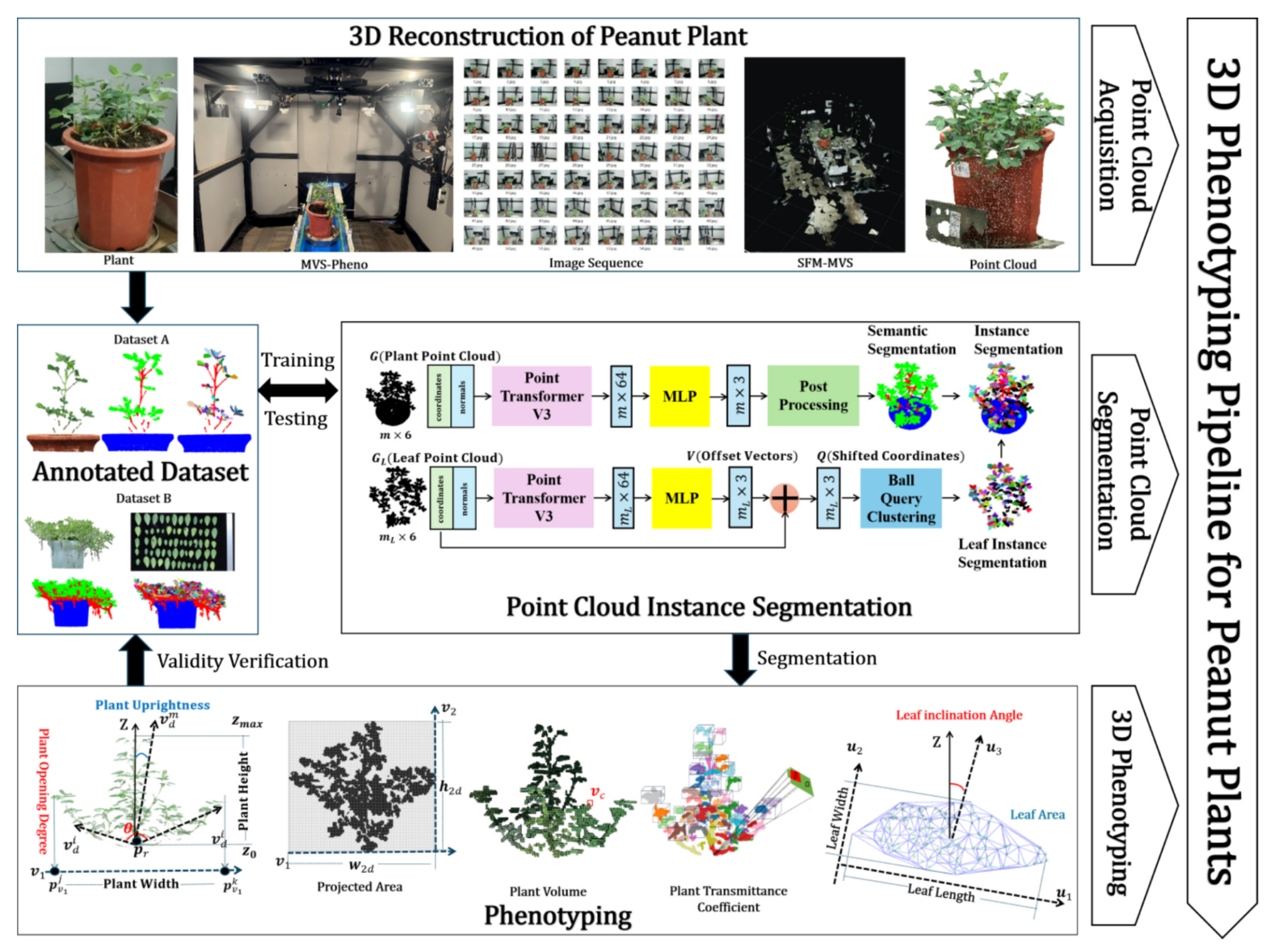
A 3D Phenotyping Pipeline for Peanut Plants Using Point Cloud
Bo Zhang, Xin Yang, Xiaodan Han, Guowei Li, Xianju Lu, Bo Bai, Haisheng Liu, Teng Miao, Sheng Wu, Xinyu Guo, Bo Zhang, Xin Yang, Xiaodan Han, Guowei Li, Xianju Lu, Bo Bai, Haisheng Liu, Teng Miao, Sheng Wu, Xinyu Guo
Computers and Electronics in Agriculture 2025
A point-cloud-based 3D phenotyping pipeline for peanut plants is developed, leveraging multi-view imaging and reconstruction to generate a dataset of 188 labeled samples. Transformer-based semantic and leaf-instance segmentation models achieve higher accuracy than conventional methods. From the segmentation results, 11 plant- and leaf-level phenotypic traits are automatically extracted, with five key traits (e.g., plant height, leaf length) showing a mean absolute percentage error (MAPE) below 0.12, and leaf trait distributions matching ground truth with Jensen–Shannon divergence under 0.1. The pipeline demonstrates strong generalization and provides an efficient tool for high-throughput peanut phenotyping in smart breeding and cultivation.
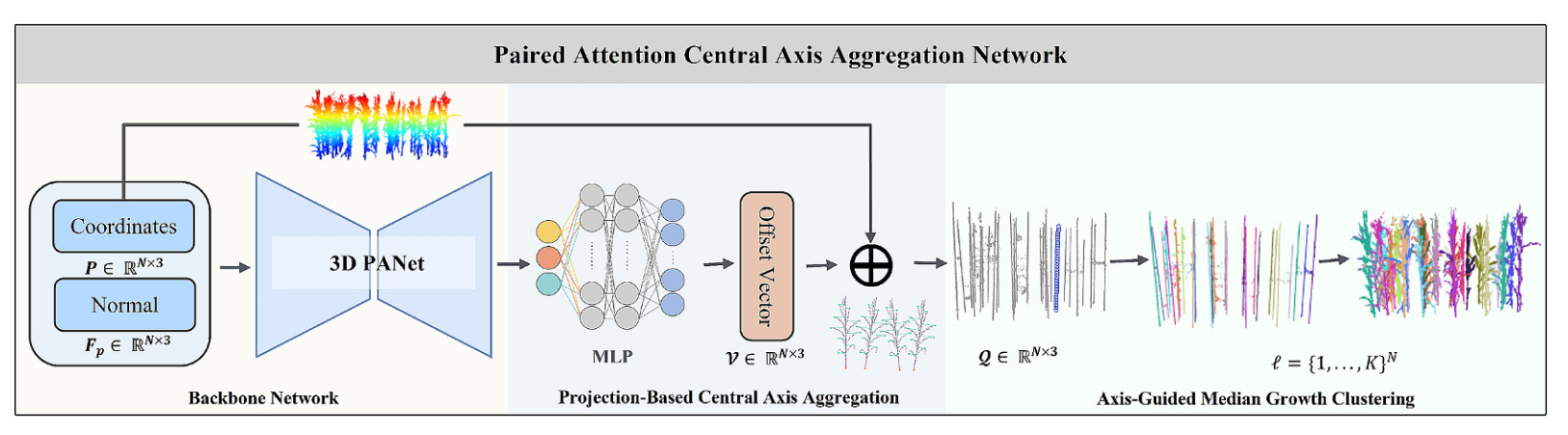
PACANet: A Paired-Attention Central Axis Aggregation Network for Plant Population Point Cloud Segmentation and Phenotypic Trait Extraction---A Case Study on Maize
Xin Yang, Teng Miao, Yitong Tao, Bo Zhang, Xiaotong Wu, Xiaodan Han, Jinshi Yu, Yuncheng Zhou, Hanbing Deng, Ying Wang, Tongyu Xu
Computers and Electronics in Agriculture 2025
A novel framework, Paired-Attention Central Axis Aggregation Network (PACANet), is proposed for segmenting individual maize plants from dense 3D canopy point clouds. It combines a 3D paired-attention backbone to enrich point-wise features and a central axis projection strategy to enhance spatial coherence during instance separation. To reduce dependency on manual annotations, simulated point clouds are used for training. PACANet achieves state-of-the-art performance with an average precision of 0.9246 using only synthetic data and enables accurate extraction of plant- and organ-level phenotypic traits across varying planting densities. The code and data are publicly available.
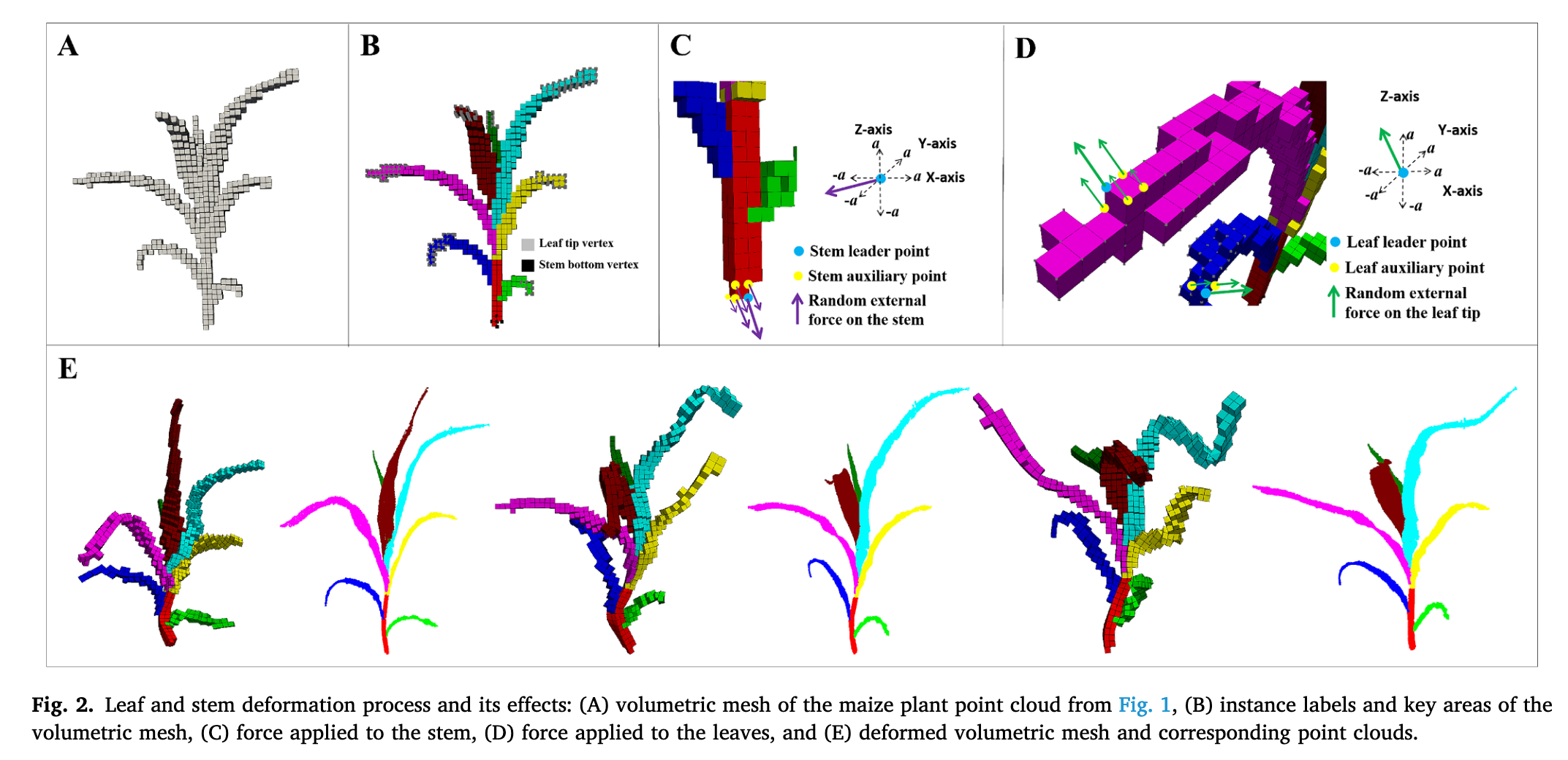
Maize Stem--Leaf Segmentation Framework Based on Deformable Point Clouds
Xin Yang, Teng Miao, Xueying Tian, Dabao Wang, Jianxiang Zhao, Lili Lin, Chao Zhu, Tao Yang, Tongyu Xu
ISPRS Journal of Photogrammetry and Remote Sensing 2024
A 3D point-cloud dataset of 428 maize plants (2-12 leaves) is introduced for stem-leaf segmentation, accompanied by a deformation-based augmentation strategy that enhances morphological diversity while preserving organ geometry. Using only 22 labeled samples, the approach achieves high segmentation accuracy—91.93% mIoU with PointNet++ and 93.74% mAP with HAIS—demonstrating efficient model training with minimal annotations. The dataset and source code are publicly available.